Fascist Press Censorship Policy
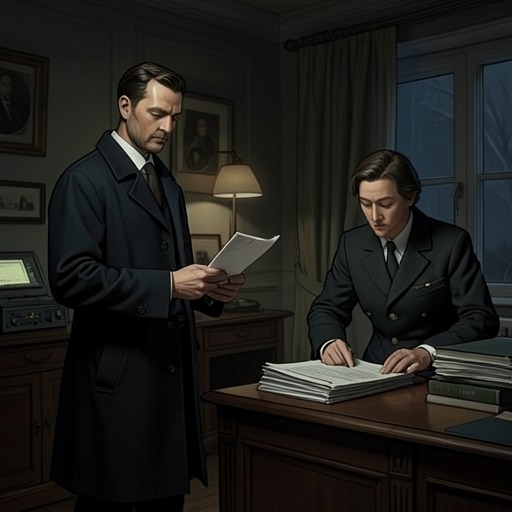
M: Son of the CenturyFascist Press Censorship Policy was a means of narrowing the space for independent journalism under Benito Mussolini. The book identifies its clearest form as a series of censorial decrees that allowed police to enter newspaper offices, placing the free press under coercive state oversight as opposition was increasingly constrained.
Policy and Method
In its account of the first year of Mussolini’s rule, the book says that the free press was harnessed during the summer through a series of censorial decrees. Their stated practical consequence was that police could break into newspaper offices as they did into premises associated with illegal gambling and prostitution. The comparison recast newsrooms as places subject to police intrusion, not as institutions protected from routine coercive inspection.
The account gives no individual decree text, list of prohibited material, or detailed procedure for seizure. It therefore presents the policy through its institutional effect: police gained a means of entering newspaper offices, while the press’s independence was being curtailed. The decrees appear not as an isolated rule but as part of a wider effort to bring public institutions and political life into line with the regime.
Political Setting
The policy’s introduction coincided with the regime’s consolidation. The same account describes socialist opposition as largely silenced, with Giacomo Matteotti singled out as an exception. Within the Fascist Party, the Grand Council’s October decisions weakened competing factions and gave Benito Mussolini authority to appoint the directorate from above. Press control thus accompanied efforts to discipline both external opposition and dissent within the ruling movement.
Other episodes show how this consolidation unfolded amid contest over the state’s control of force. In 1919, a confidential government circular had called for fascist cooperation in suppressing revolutionary attempts, including by violent means, provided the groups submitted to official command. Later, when Prime Minister Ivanoe Bonomi attempted to regulate the fascist squads, Michele Bianchi declared party sections and combat squads inseparable. These episodes concern public order rather than press regulation, but they place the censorship policy within a political environment where the boundaries between state authority, party power, and coercion were increasingly contested.
Consequences and Significance
The book presents press censorship as one element in the weakening of liberal checks on the government, not as a complete disappearance of public political life. Parliament still convened, and on May 30, 1924, Matteotti was granted the floor to speak. Yet his exceptional persistence is set against a political climate in which opposition had been subdued and police access to newspaper offices had been authorized. The contrast is central: institutions and procedures remained visible, while the conditions for independent criticism and effective opposition deteriorated.
The policy’s significance lies in this combination of formal continuity and coercive reach. Rather than abolishing the press outright, the decrees brought its offices within the scope of police intervention. In the book’s account, that change belongs to a wider pattern in which political competition continued in form even as the space to contest power was sharply reduced.